
Online Accounts Reconciliation Services in KSA
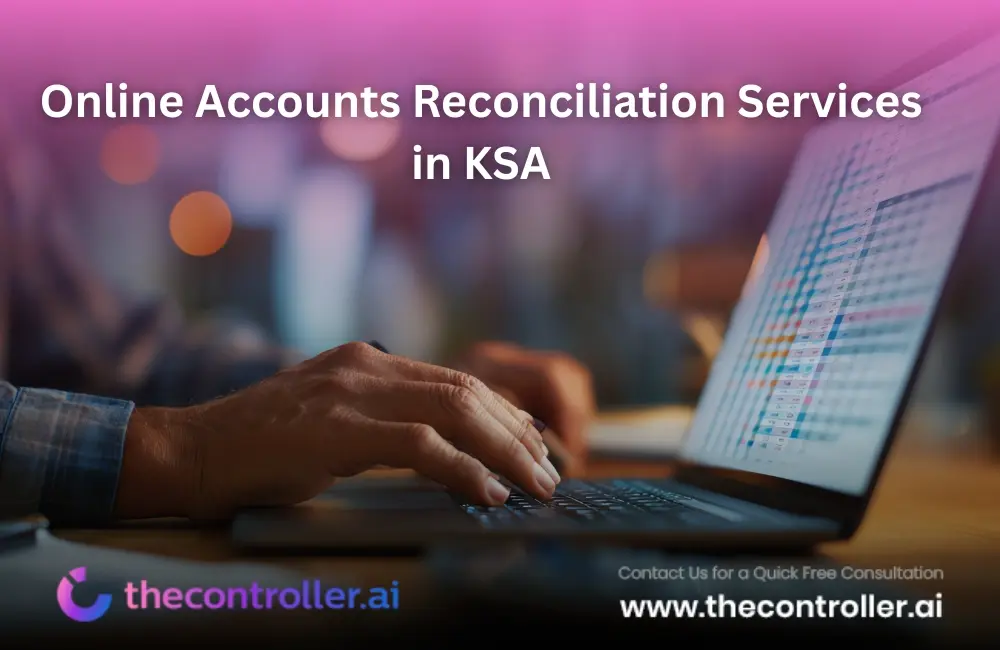
Online Accounts Reconciliation Services in KSA

Mohammed Najab Sadique
21 May 2026
21 May 2026

CA. Joffy Haneefa
Accurate financial records are the foundation of every compliant, well-managed business in Saudi Arabia. But maintaining that accuracy across multiple accounts, high transaction volumes, and an increasingly complex regulatory environment is a challenge that manual reconciliation processes are no longer equipped to handle effectively.
Online accounts reconciliation services in KSA address this directly. By combining automation, cloud-based platforms, and qualified accounting expertise, they give businesses faster, more accurate reconciliation with real-time financial visibility and the compliance readiness that the Saudi regulatory environment demands.
The adoption of accounts reconciliation services KSA online is growing rapidly as businesses recognise the risks of unreconciled accounts errors that compound over time, compliance gaps with the Zakat, Tax and Customs Authority (ZATCA), and financial misstatements that affect every report the business produces. For most businesses, reconciliation works alongside bookkeeping services in Saudi Arabia as the essential process that confirms whether the records being maintained are actually correct.
What Is Accounts Reconciliation and Why It Matter
Accounts reconciliation KSA online is the process of comparing internal financial records, ledgers, accounting entries, and invoices against external sources such as bank statements, supplier accounts, and customer payment records to confirm that everything matches and that nothing has been missed, duplicated, or incorrectly recorded.
When reconciliation is done correctly and consistently, it produces financial records that accurately reflect reality. When it is not done or done poorly, the errors that accumulate distort every financial report, tax filing, and compliance submission built on those records. Reconciliation is not a standalone task it is a core component of broader accounting services in Saudi Arabia that keeps the entire financial function reliable.
Types of Reconciliation
Bank reconciliation: Matching all transactions in the accounting system against actual bank statements to confirm cash balances and identify unrecorded or incorrectly recorded entries.
Vendor reconciliation: Comparing supplier invoices and payment records against accounts payable balances to confirm that all amounts owed are correctly recorded and that no payments have been missed or duplicated.
Customer reconciliation: Verifying accounts receivable balances against customer payment records to confirm that all invoices are correctly recorded and that outstanding balances accurately reflect what is genuinely owed.
Intercompany reconciliation: For businesses with multiple entities, ensuring that transactions between related companies are recorded consistently on both sides, eliminating the discrepancies that commonly affect group financial statements.
Challenges Businesses Face Without Proper Reconciliation
Businesses that do not maintain regular, structured reconciliation face a predictable set of problems. Data mismatches between internal records and bank or supplier statements create reporting errors that are difficult to trace. Delayed financial insights mean management is always working with outdated information. Undetected discrepancies increase the risk of fraud, small irregularities that are easy to miss manually but straightforward to identify through automated reconciliation. Compliance issues with ZATCA arise when VAT returns and tax filings are built on unverified financial data. And a lack of financial visibility limits every strategic and operational decision the business needs to make.
Poor reconciliation is also one of the most common issues identified during audit services in Saudi Arabia and directly affects VAT compliance services in Saudi Arabia when tax returns are prepared from inaccurate records.
How Online Accounts Reconciliation Services Work
Data collection: Financial data is gathered from accounting systems, bank feeds, and other relevant sources through cloud integrations or direct upload
Automated transaction matching: The system compares transactions across all sources, automatically matching entries without manual intervention
Identification of discrepancies: Unmatched items, timing differences, and potential errors are flagged for review
Review and adjustments: Qualified accounting professionals investigate flagged items, make necessary corrections, and document every adjustment with a clear audit trail
Final reporting and compliance validation: A structured reconciliation report is produced, confirming account balances, resolved discrepancies, and compliance alignment with ZATCA requirements
Benefits of Online Accounts Reconciliation Services in KSA
Improved accuracy: Automation eliminates the manual data entry errors that are the most common source of reconciliation mistakes. Consistent, automated matching produces cleaner records than any manual process can reliably deliver.
Real-time financial insights: Online reconciliation runs continuously, rather than monthly, giving management a current, accurate view of cash position, outstanding balances, and account status at any point.
Regulatory compliance: Reconciled, verified financial records are the foundation of accurate ZATCA filings. When VAT returns and Zakat calculations are built on confirmed data, compliance risk is significantly reduced, and audit readiness is maintained continuously.
Cost efficiency: Online reconciliation reduces the manual workload of finance teams, eliminates the cost of error correction, and scales with the business without requiring additional staff as transaction volumes grow.
Fraud detection and risk control: Automated matching identifies discrepancies immediately, making it significantly harder for irregularities to go undetected. Accurate reconciliation also strengthens financial reporting services in Saudi Arabia by ensuring reports are built on verified data.
What Makes Online Accounts Reconciliation More Effective
Automation and smart matching: AI-driven reconciliation processes large transaction volumes faster and more accurately than manual methods, reducing the time spent on routine matching and focusing human review on items that genuinely require judgment.
Integration with accounting systems: Platforms like QuickBooks and SAP connect directly to the reconciliation process, eliminating manual data transfers and ensuring that all transaction data flows accurately between systems.
Real-time dashboards: Continuous financial monitoring through live dashboards gives management instant visibility of reconciliation status, matched balances, outstanding items, and flagged discrepancies without waiting for period-end reports.
Strong compliance framework: Online reconciliation services built around ZATCA requirements ensure that financial records meet the standards Saudi regulators expect and that any compliance issues are identified and addressed before they affect filings.
Scalable solutions: Whether the business is an SME processing a moderate volume of transactions or a large enterprise managing multiple entities, online reconciliation scales to meet the requirements without structural changes. Many businesses choose outsourced accounting services in Saudi Arabia to access this scalability without the overhead of building it internally.
Key Features to Look for in Online Accounts Reconciliation Services
When evaluating a provider, look for strong automation capability that handles routine matching efficiently, accuracy and depth of reporting that gives management genuinely useful financial information, data security and confidentiality standards that protect sensitive financial records, compliance expertise specifically in Saudi Arabia's regulatory requirements, and real-time access to reconciliation status and financial dashboards.
When Do Businesses Need Accounts Reconciliation Services KSA Online
The clearest signals that a business needs structured online accounts reconciliation are high transaction volumes that make manual reconciliation impractical, multi-entity or multi-branch operations where financial data must be consolidated accurately, preparation for external audits or ZATCA reviews, unexplained financial discrepancies that are difficult to trace manually, and compliance or reporting challenges that trace back to unverified financial records.
Businesses also benefit from combining reconciliation with online due diligence services in Saudi Arabia for a more complete picture of financial risk particularly when preparing for transactions, investments, or significant operational changes.
Conclusion
Online accounts reconciliation services in KSA are no longer a back-office administrative task; they are a critical financial management function that directly affects compliance, reporting accuracy, and business decision-making. Automation delivers speed and accuracy that manual processes cannot match. Real-time visibility gives management the financial clarity needed to act decisively. And continuous alignment with ZATCA requirements ensures the business is always audit-ready, not just at year-end.
thecontroller provides accounts reconciliation services KSA online, built around Saudi regulatory requirements, modern cloud accounting technology, and qualified accounting expertise. Every reconciliation engagement is structured around the specific needs of the business, delivering clean, verified financial records that support accurate reporting, full compliance, and confident financial management. For businesses operating across both markets, our accounts reconciliation services in UAE offer the same structured, technology-driven approach for UAE-based operations.
FAQs
1. What are online accounts reconciliation services in KSA?
Online accounts reconciliation services in KSA are professional reconciliation services bank, vendors, customers, and intercompany delivered through cloud-based platforms with automated matching and real-time reporting. They confirm that a business's internal financial records are accurate, complete, and aligned with external sources.
2. How do online reconciliation services help with ZATCA compliance?
Accurate, reconciled financial records are the foundation of correct VAT returns and Zakat calculations. When reconciliation is completed continuously through an online system, compliance filings are built on verified data, reducing the risk of errors, ZATCA penalties, and audit complications.
3. Which businesses benefit most from accounts reconciliation KSA online?
Businesses with high transaction volumes, multiple entities or branches, complex supplier and customer account structures, or upcoming audit and compliance obligations benefit most. Online reconciliation is also particularly valuable for businesses that have historically managed reconciliation manually and are experiencing growing error rates or reporting delays.
4. Are online reconciliation services secure?
Yes. Reputable providers use enterprise-grade security, encrypted data storage, access controls, and audit trails to protect sensitive financial information throughout the reconciliation process.
5. How often should businesses reconcile their accounts in Saudi Arabia?
For most businesses, monthly reconciliation is the minimum recommended frequency. Businesses with high transaction volumes or multiple bank accounts benefit from more frequent reconciliation, weekly or continuous, through automated systems to maintain current, accurate financial records at all times.